Explore · Stay · Experience · Support Local India's #1 Platform for Himachal Pradesh

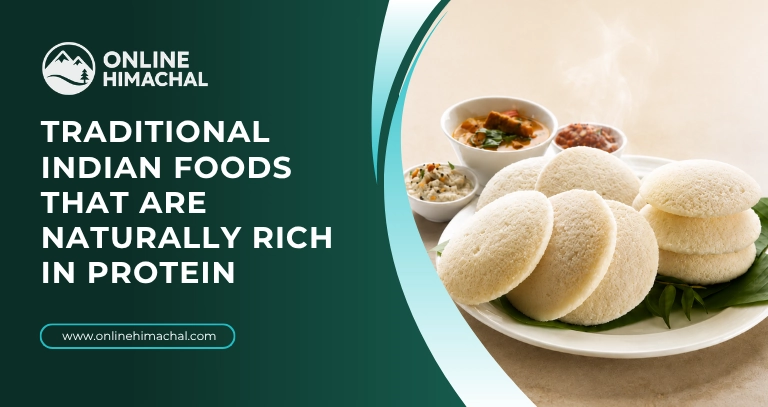
Protein may seem like a modern nutrition obsession, but Indian kitchens have been serving it for generations. In fact, a lot of traditional Indian foods naturally combine different sources of protein in the same meal. Even a plate of idli with sambar at an authentic South Indian restaurant or pesarattu with chutney combines pulses, grains and fermented foods.
It’s all about knowing which traditional foods are higher in protein and how to combine them well.
Why Does the Traditional Indian Plate Work So Well for Protein?
A vegetarian diet requires variety because different plant foods contain different amounts and combinations of amino acids.
The traditional Indian meal creates that variety without complicating nutrition. Dal is eaten with rice or roti, and curd is a side dish to grains. The legumes are often the main part of a complete meal.
Some familiar combinations include:
- Dal with rice
- Rajma with rice
- Chole with roti
- Khichdi with curd
- Idli with sambar
- Millet roti with dal
These combinations also explain why protein should be judged across the whole meal rather than by looking at one ingredient alone.
Which Traditional Foods Give You the Most Protein?
Pulses and Dals
In India, dal is one of the easiest vegetarian sources of protein. It is already used in everyday cooking and is quite affordable and versatile.
Many common pulses contain around 22-25 g protein per 100 g dry weight basis.
Available options are:
- Masoor dal: about 25 g/100 g dry
- Urad dal: approx. 25 g
- Moong dal: about 24 g
- Toor dal: about 22 g
- Chana dal: 22 g (approx.)
Cooking alters the amount per 100 g as the pulses absorb water, so a standard bowl contains less protein than the dry figures would imply.
But dals are worth having, because they appear so often in Indian meals. They are the backbone of tadka dal, sambar, khichuri and many regional delicacies.
Whole Legumes
Rajma, kala chana, Kabuli chana and lobia take protein a step further and bring plenty of fibre too.
A cup of cooked rajma or chickpeas, depending on the quantity and preparation, can give around 14- 15 g of protein.
This is a good thing because these foods can be the main part of lunch, not just a small side dish.
Think of:
- Rajma-chawal
- Chole with roti
- Kala chana curry
- Lobia curry
- Chickpea sundal
Among traditional Indian foods, legumes are especially useful for anyone trying to increase protein without completely changing familiar eating habits.
Where Do Paneer, Curd and Milk Fit In?
Dairy is another easy vegetarian protein source.
Paneer, with about 18g of protein per 100g, can be the centrepiece of a meal. Curd and milk have less, but if consumed regularly, they become important.
Paneer can be prepared as tikka, bhurji or curry. Curd is served with dal-rice, paratha or khichri. Kadhi is a popular dish made of gram flour and curd.
Rather than depending on one large protein-heavy dish, these foods help distribute protein across the day.
Do Millets, Nuts and Seeds Count Too?
Yes, but they are best used as supporting sources and not to replace pulses or legumes.
Bajra has about 11- 12 g protein in 100 g dry grain, and jowar has about 10 g. Ragi is a source of nutrients like calcium, but it is poor in protein.
When eaten with dal or curd, traditional millet-based foods such as bajra roti, jowar bhakri and ragi mudde have higher nutritional value.
Nuts and seeds can add another small boost. Peanuts contain around 26 g of protein per 100 g, while almonds provide roughly 21 g.
Indian cooking already uses them naturally through:
- Peanut chutney
- Sesame chutney
- Roasted chana and peanuts
- Til preparations
- Groundnut-based gravies
This is an important point: improving protein intake does not always mean adding another full dish.
Can a Healthy South Indian Breakfast Be Protein-Rich?
Certainly. A healthy South Indian breakfast can bring together grains, pulses and fermented foods in one meal.
Take idli and sambhar, for example. Idli is made from rice and urad dal. Another lentil on the plate is sambar.
Other useful breakfast choices include:
Pesarattu
Made mainly from green gram, pesarattu naturally contains more protein than many plain cereal-based breakfasts.
Adai
In adai, rice is generally combined with different dals such as chana dal, toor dal and urad dal. Depending on size and recipe, 2 pieces may give approx. 12- 14 g protein.
Veg Pongal
In this comfort food preparation, rice is combined with moong dal, making it nutritionally more balanced than plain rice.
Idli and Sambar
Instead of having idli with just a bit of chutney, the addition of a healthy portion of sambar increases the lentils in the meal. There are many types of sambar you can choose to eat your idli with.
So, a healthy South Indian breakfast should be considered as a full plate and not only one dish.
The same idea applies when eating out. If you are visiting a South Indian restaurant in Gurgaon, choosing lentil-rich dishes such as idli with sambar, pesarattu, or adai can make breakfast more balanced without making it feel like “diet food”.
How Can You Add More Protein Without Changing Your Usual Diet?
Small changes often work better than completely replacing traditional meals.
Here are some practical tweaks to try:
- Increase the dal portion: Don’t think of dal as just a spoonful of gravy.
- Add curd: Perfect to pair with lunch or dinner.
- Snack on legumes: Sundal, roasted chana and chana chaat are easy options.
- Choose better side dishes: More sambar with idli or dosas.
- Pair millet rotis with dal or curd.
- Use nuts and seeds in chutneys: Peanut and sesame chutneys can add both flavour and nutrition.
This approach keeps traditional Indian foods at the centre of the diet rather than replacing them with highly processed alternatives.
Traditional Food Already Has More to Offer
You don’t need supplements or any weird ingredients to start a high-protein diet. Dals, beans, paneer, curd, millets, nuts and fermented foods are already present in Indian kitchens and can work naturally.
A little attention to portion sizes and combinations can make a big difference. So, even if you are dining at a South Indian restaurant in Gurgaon, you can still enjoy familiar flavours while building a more balanced meal by choosing a healthy South Indian breakfast with lentil-rich dishes and accompaniments.
The smartest approach may simply be to look again at the foods Indians have been eating all along.
Also Read : Top 12 Traditional Foods of Himachal Pradesh